How to Pay Nail Technicians: Commission, Hourly or Chair Rent
How to pay nail technicians: hourly pay, commission, chair rent or a mix. How to work out the commission you can afford, with a worked example.
By the CutieCure Salon teamPublished 7 min read
In short
- There are three basic models: hourly or salaried pay, commission on the services a technician performs, and chair rent, where a self-employed technician pays you a fixed rent and keeps her own takings. Many salons mix them, for example a base wage plus commission.
- Work out the commission you can afford from your own numbers: start from 100% of service revenue, subtract product cost, the technician's share of overhead and the profit you need. What is left is the most you can pay.
- Write the rules down before anyone is paid: what counts as revenue, discounts, product charges, fixes, no-shows and tips. Most pay disputes come from rules nobody wrote down.
The three ways salons pay nail technicians
- Hourly or salaried pay: the technician earns the same for every hour she works, busy or quiet. It is predictable for her and simple to run, but the salon carries the risk of slow days, and pay does not reward a full calendar.
- Commission: the technician earns a share of the revenue from the services she performs. Pay follows bookings, so the risk of a quiet month is shared, and good technicians earn more. It needs clear rules and reliable numbers per person.
- Chair rent (booth rent): the technician is self-employed. She pays the salon a fixed weekly or monthly rent for a station and keeps what she earns. The salon gets a steady income and fewer staff costs, but much less say over prices, hours and how clients are treated.
Hybrids are common. A base plus commission model pays a small fixed wage and a commission on top. A "whichever is higher" model pays the guaranteed hourly amount or the commission, whichever is more for the period, which protects a technician while her calendar fills. Tiered commission raises the percentage when monthly revenue passes agreed levels.
Work out the commission you can afford
Commission rates copied from another salon are a guess. Your affordable rate depends on your own costs. Use a month of numbers for one technician, or enter them in the free nail tech commission calculator:
- 1Service revenue: what her completed services brought in during the month, after discounts.
- 2Product cost: gel, polish, tips, files and other consumables, as a share of that revenue. The nail service price calculator helps you estimate product cost per service.
- 3Overhead share: her part of rent, utilities, software, marketing, insurance and front-desk time, as a share of her revenue.
- 4Target profit: the margin the salon needs to stay healthy and invest.
- 5Affordable commission = 100% minus product cost, overhead share and target profit.
A worked example with round numbers. A technician performs 6,000 of services in a month. Products are about 10% (600). Her share of overhead is about 30% (1,800). The salon wants 15% profit (900). That leaves 45%, or 2,700, as the most the salon can pay her in commission.
Compare that with hourly pay. If the same technician works 160 hours at 15 an hour, her pay is 2,400 before employer costs such as payroll taxes and benefits, which depend on the country. In a busy month commission pays her more; in a quiet month the hourly model costs the salon more than the work brought in.
The commission rules people argue about
Write these into the pay agreement so the monthly calculation is never a negotiation:
- What counts as revenue: completed services only, at the price the client actually paid after any discount or campaign code.
- Product charge: some salons pay commission on revenue minus a fixed product fee per service; others build product cost into a lower percentage. Pick one, not both.
- Fixes and redos: a free fix within your guarantee period earns no new commission, because no new revenue came in.
- No-shows and late cancellations: no service, no commission. If you keep a deposit or charge a late fee, decide in advance whether any of it goes to the technician.
- Retail: products sold to clients usually earn a separate, lower commission than services.
- Tips: tips belong to the technician. Many countries have rules on how tips paid by card are passed on, so check yours.
Fairness matters as much as the rate. When pay depends on bookings, the way "anyone available" bookings are shared becomes a pay question too. The guide to running a multi-staff nail salon covers assignment that technicians can trust.
If you offer chair rent
Chair rent works best with experienced technicians who already have their own clients. Put the arrangement in writing:
- Rent: the amount, when it is due and what happens if it is late.
- What is included: station, chair, lamp, storage, water, Wi-Fi, laundry, and whether any products are included.
- Prices and hours: a self-employed technician normally sets her own prices and schedule. If you need to control them, you are probably describing an employee.
- Clients and bookings: whose booking link the clients use, and who keeps the client list if she leaves.
- Insurance, licences and taxes: who holds which insurance and registrations.
- Notice: how much notice either side gives to end the arrangement.
Paying a new technician
A new technician has no regulars yet, so commission alone can leave her with very little in the first months. Two common fixes: pay hourly during training and switch to commission once she is signed off, or pay commission with a guaranteed minimum for an agreed period. The 30-day plan for training a new nail technician shows how to fill her calendar gradually and when to review her numbers.
Keep the numbers per technician
Any pay model except a flat salary needs reliable numbers per person: revenue from completed services, appointments, no-shows and how full the calendar was. Review them monthly, not only on payday. The guide to nail salon KPIs explains which ones to watch.
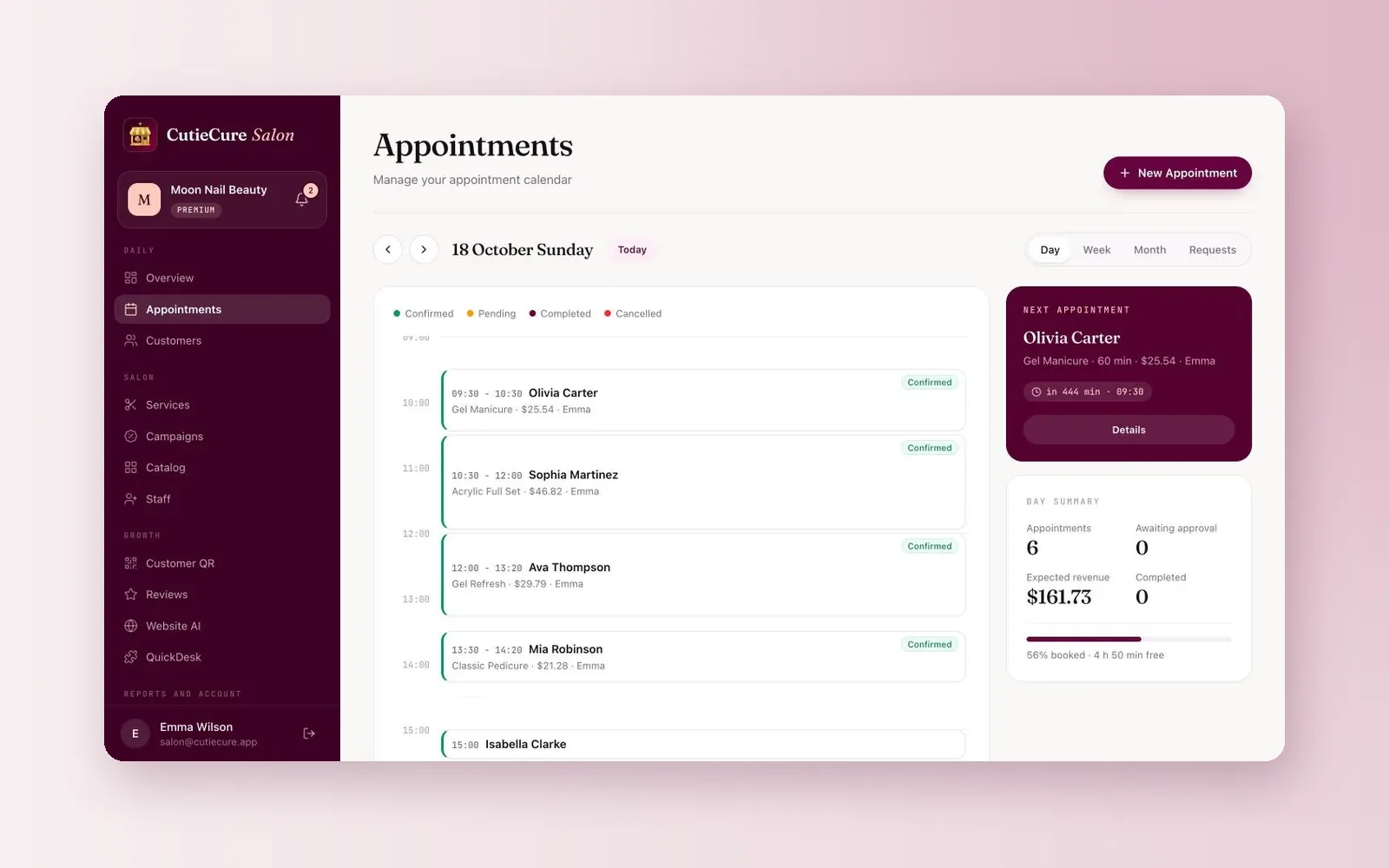
In CutieCure Salon every appointment is booked to a team member, and the staff performance view shows revenue, appointments, no-show rate, utilization and average ticket per person for the last 7, 30 or 90 days. That is enough to check that a pay model is fair and to spot a technician whose calendar is thinning. It is not a payroll system: calculate the actual pay in your payroll or accounting tool.
Choosing a model in five steps
- 1Pull three months of revenue, product cost and overhead per technician.
- 2Calculate the affordable commission for a busy and a quiet month.
- 3Compare it with the hourly cost of the same hours, including employer costs.
- 4Pick the model (or hybrid) and write the rules: revenue, discounts, product charge, fixes, no-shows, retail and tips.
- 5Review after three months with the team, using the same numbers.
Free tools and next steps
- Nail tech commission calculatorFind the commission rate you can afford and compare what the technician and the salon get under commission, hourly pay and chair rent.
- Appointment and scheduling software for nail salonsOnline booking, per-technician scheduling, client notes and no-show tracking for nail salons. No booking commission, 14-day free trial, no card.
Frequently asked questions
What is the best way to pay nail technicians?
It depends on your costs and your team. Hourly pay is predictable, commission ties pay to bookings, and chair rent suits self-employed technicians with their own clients. Many salons use a base wage plus commission.
How do I calculate nail technician commission?
Start from 100% of a technician's service revenue, subtract product cost, her share of overhead and your target profit. For example, 10% products, 30% overhead and 15% profit leave at most 45% for commission.
Should commission be paid before or after discounts?
After. Pay commission on what the client actually paid, so discounts and campaign codes reduce the commission in proportion and the salon does not pay commission on money it never received.
Do nail technicians get commission on no-shows?
Usually not, because no service was performed and no revenue came in. If the salon keeps a deposit or late fee, agree in writing whether part of it goes to the technician.
Is chair rent better than commission?
Chair rent gives the salon a fixed income and less admin, but little control over prices, hours and clients. It suits experienced, self-employed technicians. Check local rules on self-employment before offering it.
Written by the team that builds CutieCure Salon, booking software for nail salons. When the product or a fact in this guide changes, we update the guide and the date above.
Put this into practice with CutieCure Salon
Online booking link, website widget, packages, customer groups, campaign codes and team performance in one dashboard, plus AI try-on for your clients.