Nail Salon Business Plan: Startup Costs and a One-Page Template
Plan a nail salon on one page: list startup costs by category, add up monthly fixed costs, find your break-even number of services and test your prices.
By the CutieCure Salon teamPublished 7 min read
In short
- A useful plan fits on one page and answers five questions: who your clients are and what you sell, where and how you work, what it costs to open, what it costs to stay open each month, and how many services you need to break even.
- Split costs into one-off startup costs (premises, furniture, equipment, first stock, permits, brand) and monthly fixed costs (rent, utilities, insurance, software, fixed pay, accountant, your own pay). Use real quotes, not averages from the internet.
- Break-even services per month = monthly fixed costs ÷ (average price − variable cost per service). Then check that those services fit in your calendar.
Why one page beats a thirty-page plan
Unless a bank or an investor asks for a long document, a nail salon needs a plan it will actually update: a single page of numbers you can check every month. A long plan written once and never opened again does not tell you when something is going wrong.
The one-page plan below is also what you need for the conversations that matter: with a landlord, a bank, a partner or yourself before you sign anything.
The one-page template
Write one or two lines for each heading:
- 1Concept and clients: what you specialise in and who it is for (for example natural nails and gel for working professionals near the station).
- 2Services and prices: a short menu with durations and prices. Start small; you can add services later.
- 3Model and location: home studio, a rented chair or room, your own salon, or mobile.
- 4Team: who works, how many hours and how they are paid.
- 5Startup costs: the total of the checklist below, with the quotes attached.
- 6Monthly fixed costs: everything you pay whether or not a client comes in.
- 7Break-even and capacity: how many services a month you need, and how many you can physically do.
- 8Money and buffer: where the startup money comes from and how many months of fixed costs you can cover while bookings build up.
- 9First 90 days: how the first clients will find you.
The last line is covered step by step in how to start a nail business. This guide is about the numbers.
Startup costs: the checklist
Costs vary too much by country, city and model for any average to be useful. Build your own figure from this list and get at least two quotes for every large item.
- Premises: deposit and any upfront rent, fit-out, plumbing for pedicure stations, ventilation or dust extraction, lighting and signage.
- Furniture: nail tables, client and technician chairs, pedicure chairs, storage, a reception or waiting area.
- Equipment: LED or UV lamps, electric files, dust collectors, tools, and cleaning and sterilisation equipment as your local rules require.
- First stock: gels, polishes, consumables and single-use items. The inventory guide shows how to buy only what you will use.
- Hygiene and safety: disinfectants, waste disposal, a first aid kit and any fire safety equipment your premises need.
- Legal and admin: business registration, any permits or licences, insurance, and setting up with an accountant.
- Brand and marketing: name, logo, sign, photos of your work and a first round of promotion.
- Software and payments: booking software, a card terminal and anything else you will pay for from day one.
Monthly fixed costs
Fixed costs are what you pay every month even if nobody books. List them all:
- Rent or chair rent, service charges and utilities.
- Insurance.
- Fixed salaries and the employer costs that come with them (see how to pay nail technicians).
- Software subscriptions, phone and internet.
- Accountant and bank fees.
- A regular marketing budget.
- Loan repayments.
- Your own pay. If the plan only works when you work for free, it does not work.
Variable cost per service
Variable costs rise with every client: products and single-use items used in the service, card payment fees, and commission if technicians are paid on commission.
To get the product cost per service, note when you open a bottle or box and count how many services it lasted; the inventory guide explains the method. For commission, the commission calculator shows what you can afford to pay.
Break-even: how many services you need
Each service contributes its price minus its variable cost towards your fixed costs. Break-even is the point where those contributions cover the month:
An example with round numbers, in any currency (these are not benchmarks): fixed costs of 3,000 a month, an average price of 40 and a variable cost of 8 per service. Each service contributes 32, so break-even is 3,000 ÷ 32 ≈ 94 services a month. Over 24 working days, that is about 4 services a day.
Now check capacity. One technician working 8 hours a day with 60-minute services can do at most 8 services a day, and no calendar is full every hour. If break-even needs most of your maximum, the plan is fragile: one quiet week or a few no-shows and you are below it.
The free break-even calculator does both steps with your own numbers: it adds commission and card fees to the variable cost, includes the pay you need to take home, and compares the result with your bookable hours.
If the numbers do not work
There are only four levers, and you can model each one before you open:
- Raise prices. Price from your costs and time, not from the salon next door. The nail service price calculator and the guide on how to price nail services show how.
- Lower fixed costs: a smaller space, a rented room or chair first, or a home studio.
- Lower variable costs: fewer product lines, better buying, less waste.
- Add capacity: longer opening hours or a second technician, once there is demand for it.
Money and a cash buffer
Bookings rarely start full. Besides the startup costs, keep cash to pay your fixed costs during the first months, while the calendar fills. Work out how many months your buffer covers, and decide whether that is enough before you sign a lease.
Also plan what you will do if bookings come in slower: which costs you could cut, and by when you would decide.
Keep the plan alive
Once you are open, compare the plan with reality every month: revenue, number of services, average price, fixed costs and how full the calendar was. The guide to nail salon KPIs lists the numbers worth reviewing.
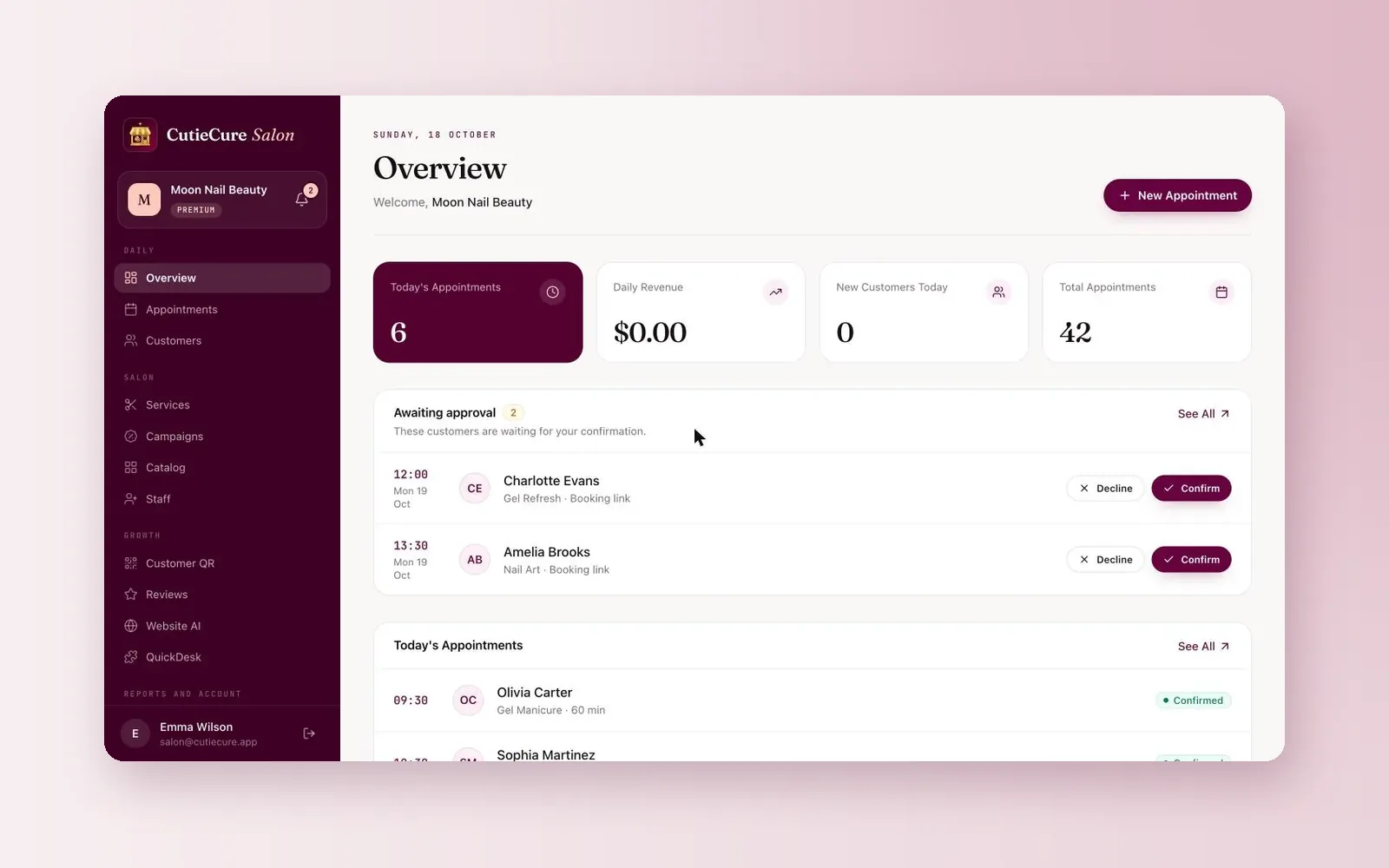
Booking software makes the capacity side easier to see. In CutieCure Salon, each technician has their own calendar, and the dashboard shows the day's appointments and expected revenue. It is a flat monthly subscription by team size, with no commission per booking, which keeps it a fixed cost you can put in the plan. It does not track stock, so keep stock in a spreadsheet.
Free tools and next steps
Frequently asked questions
What should a nail salon business plan include?
Your concept and clients, services and prices, model and location, team, startup costs, monthly fixed costs, break-even and capacity, where the money comes from with a cash buffer, and how you will find your first clients.
How much does it cost to open a nail salon?
It depends heavily on the country, the city and the model: a home studio or rented chair costs far less than a salon that needs a fit-out. Build your own figure from quotes, using the startup cost checklist in this guide.
How do I calculate the break-even point of a nail salon?
Divide your monthly fixed costs by the average price of a service minus its variable cost (products, card fees, commission). The result is the number of services you need each month.
How many clients a day does a nail salon need?
Divide your break-even number of services by your working days in the month, then compare it with how many services your team can actually fit into a day.
Is a home nail studio cheaper to start?
Usually, because there is no separate rent or fit-out. Check the local rules for working from home, your insurance and your privacy before you start.
Written by the team that builds CutieCure Salon, booking software for nail salons. When the product or a fact in this guide changes, we update the guide and the date above.
Put this into practice with CutieCure Salon
Online booking link, website widget, packages, customer groups, campaign codes and team performance in one dashboard, plus AI try-on for your clients.