Nail Tech Back Pain and Ergonomics: Protect Your Body for a Long Career
Nail technician ergonomics: set up chair, table and lamp, use the e-file without strain, take micro-breaks, plan the schedule, know when to see a doctor.
By the CutieCure Salon teamPublished 9 min read
In short
- Set the station to your body: chair and table height, forearm support and a client hand cushion, so you sit upright with relaxed shoulders, and bring the client's hand to you, not you to the hand.
- Hold the electric file lightly and let the bit do the work, take short movement breaks between clients, and do not stack long services back to back.
- Use extraction and ventilation for dust and fumes, good light for your eyes, and see a doctor or physiotherapist if pain persists or you notice numbness or tingling. This is general advice, not medical advice.
- 1. Why your body is part of the business
- 2. Set up the station to fit you
- 3. Light and eye strain
- 4. Posture habits: bring the hand to you
- 5. Use the electric file without straining your hand
- 6. Breaks and micro-stretches between clients
- 7. Plan the schedule so long services do not stack
- 8. Dust and fumes
- 9. When to see a doctor or physiotherapist
- 10. How CutieCure Salon helps you plan a lighter schedule
Why your body is part of the business
Nail work is precise, close-up and repetitive: the same small wrist and finger movements, hours a day, while leaning towards a client's hand. Over a career, how you sit, file and plan your day decides whether you still enjoy full days or start to dread them.
Good ergonomics is not one perfect posture. It is a station that fits you, habits that keep you moving and a schedule that leaves room to recover.
Set up the station to fit you
Chair and table height
- Chair: adjustable height with lower-back support. Sit with your feet flat on the floor or a footrest, hips level with or a little above your knees.
- Table: your forearms rest on it while your shoulders stay relaxed, not lifted towards your ears. Table too high? Raise the chair and add a footrest. Too low? Raise the work, or you will lean forward all day.
- Pedicure station: an adjustable stool and a footrest that brings the client's foot up to you, instead of you folding down to it.
Supports, tools, screen and phone
- Forearm or wrist rests: a padded table edge, gel pads or a folded towel, so your wrists stay close to straight.
- A client hand cushion that lifts her hand towards you. A firm cushion at the right height often does more for your neck than any stretch.
- Tools within reach: the file, brushes, wipes and the next colour in front of you, not behind you or at the far end of the table.
- Phone and screen at eye level: if you check the calendar at your station, use a phone stand or leave the phone at the desk, rather than looking down at it on the table.
Light and eye strain
Poor light makes you lean in, squint and tense your neck. Light is an ergonomic tool, just like the chair.
- Task lamp: bright, neutral light placed so your own hand does not shadow the nail. For a right-handed technician, light from the left and slightly in front often works; move it until the shadow is gone.
- Room light and glare: keep the whole room evenly lit, angle the lamp down rather than at your face, and work on a matt mat instead of a shiny top.
- Curing lamp: within reach without twisting, and avoid looking straight into its light.
- Magnification: if you keep leaning closer, a magnifying lamp or reading glasses bring the detail to you.
Between steps, look across the room for a few seconds, and have your eyes checked regularly by an optician or eye doctor.
Posture habits: bring the hand to you
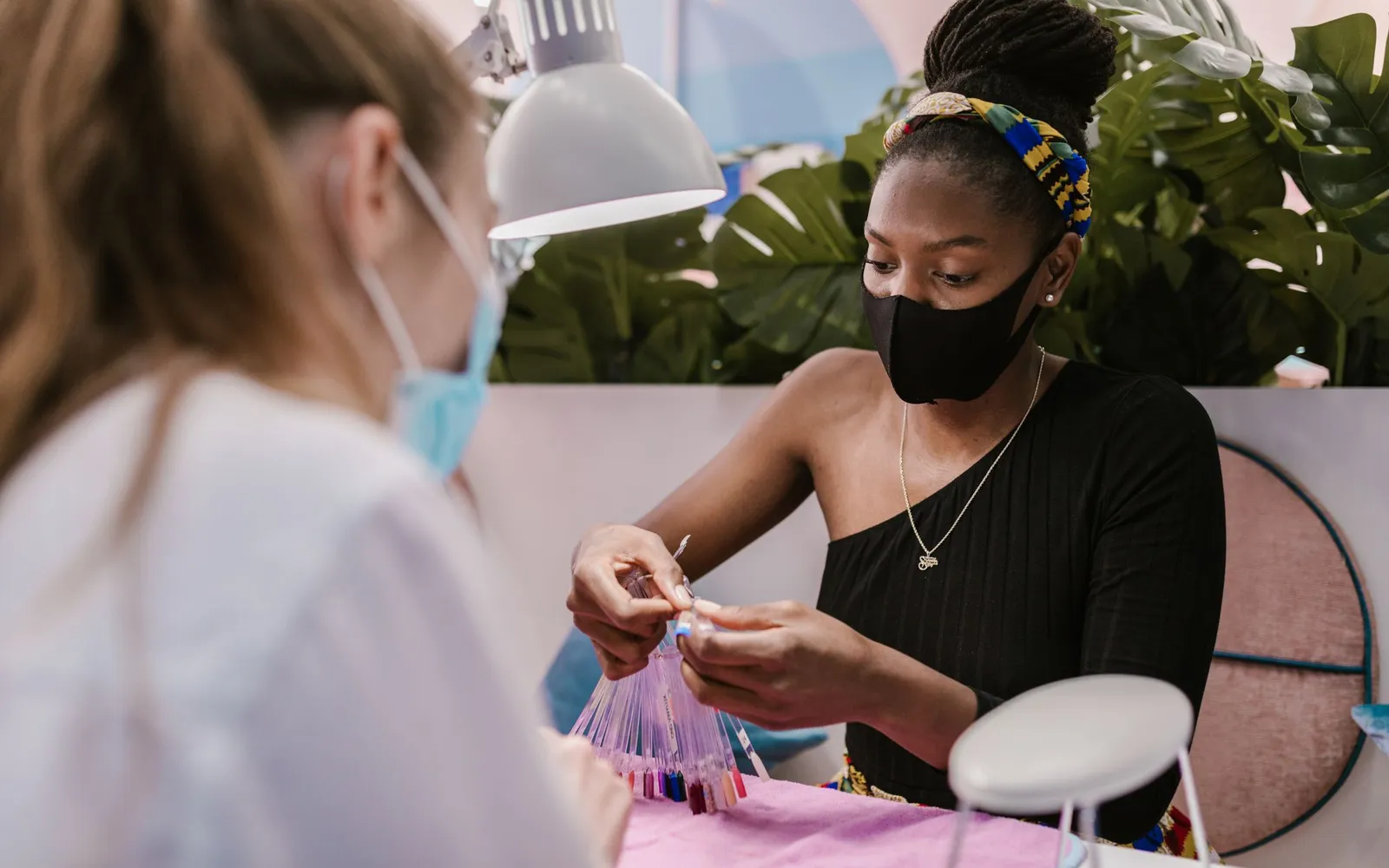
The most useful habit is simple: bring the client's hand to you, not you to the hand. Ask her to turn her hand, lift a finger or slide closer, and adjust the cushion, instead of bending, twisting or lifting your elbow.
- Sit back in the chair with your back supported and your head over your shoulders, not pushed towards the nail.
- Keep elbows close and shoulders low. If a shoulder creeps up, the hand is too high or too far away.
- Rotate her hand for side walls and thumbs instead of bending your wrist into awkward angles.
- Change position during long services: sit back between steps and stand up while the gel cures or when you fetch a colour.
- Avoid crossing your legs or sitting on one foot. The pelvis twists and the back follows.
No position stays comfortable for hours: start from a good one and move often. If you train new technicians, teach these habits in the first week, like hygiene; the 30-day training plan is a good place to add them.
Use the electric file without straining your hand
An electric file saves time, but a tight grip and heavy pressure make your hand and forearm work far harder than they need to.
- Hold it lightly, like a pen, with your fingers rather than a clenched fist.
- Let the bit do the work: a speed that suits the bit and the product, with light pressure. If you have to press hard, the bit may be worn or the wrong one.
- Support your hand by resting your little finger or the side of your hand on the client's hand or the cushion.
- Keep your wrist close to straight and move the client's hand to change the angle.
- Let the cord hang freely, for example over your forearm or from a hook, so it does not drag on the handpiece.
Breaks and micro-stretches between clients
Short, regular movement breaks are easier to keep than one long break you never take. Between clients, take a minute for simple movements like these:
- 1Stand up and walk a few steps.
- 2Roll your shoulders slowly backwards a few times, then let them drop.
- 3Turn your head gently to look over one shoulder, then the other.
- 4Open your hands wide, then close them into a loose fist, a few times.
- 5Look out of the window or across the room for a few seconds.
Plan the schedule so long services do not stack
Ergonomics is also a calendar question. Three full sets back to back, with no time between them, will wear out even the best-equipped technician.
- Set realistic durations, including the minutes you need to clean and reset the station. If the menu gives a service less time than it takes, every booking runs late and the breaks disappear. See the service menu guide, and price the real time with the price calculator.
- Mix long and short services, for example a full set followed by a gel polish manicure rather than another full set.
- Keep a real lunch break in the calendar so it does not get booked over.
- Watch the load per person. If one technician is always fuller than the others, or gets all the long sets, share the work out. The multi-staff guide covers balancing a team.
- Talk about pay and workload. On commission, a technician may take every extra booking even when tired; the pay guide covers the rules worth writing down.
Dust and fumes
Filing dust and product vapours come with nail work. Reduce them at the source first, then ventilate.
- Extraction at the table: a table extractor close to where you file catches dust before it reaches your face. Clean or replace filters as the manufacturer says.
- Ventilation: fresh air through windows or a ventilation system. A fan that only moves the same air around is not the same thing.
- Closed containers: lids on bottles, small amounts of liquid in a covered dish, and a lidded bin for wipes and used product.
- Masks and gloves: follow your local health and safety guidance and the product safety data sheets. Not every mask is made for fine dust or vapours, so check which type is recommended.
Add extraction and ventilation checks to the daily list in your hygiene checklist. Rules for salons differ by country, so check what applies where you work.
When to see a doctor or physiotherapist
Some tiredness after a long day is normal. These signs deserve a professional opinion early:
- Pain in your back, neck, shoulders, wrists or hands that does not go away with rest, or keeps coming back.
- Numbness, tingling or pins and needles in your fingers or hands, or a weaker grip.
- Pain that wakes you at night or makes everyday tasks difficult.
- Headaches, blurred vision, coughing or irritated eyes that keep returning after work.
Start with a doctor, who can refer you to a physiotherapist or specialist, and describe your work: the posture, the electric file, the hours. If you own the salon, make it easy for your team to mention these problems and to lighten their schedule while they recover.
How CutieCure Salon helps you plan a lighter schedule
CutieCure Salon cannot set your chair height, but it can help you build a calendar that leaves room to breathe.
- Durations drive free slots. Under Services, each service has a duration in minutes, and that is how much of the calendar a booking takes. There is no separate buffer setting, so build clean-up and reset time into the duration.
- Online bookings per team member. In Staff, switch Takes bookings off for a technician who should not appear on your booking page, for example while she works reduced hours. At least one person must take bookings.
- "Anyone" spreads the work. Clients who choose "Anyone" are booked with the least busy free technician.
- Utilization per person. The Performance tab in Staff shows each team member's revenue, appointments, no-show rate and utilization for the last 7, 30 or 90 days. Someone always far fuller than the others is the first person to ask how she is coping. The KPI guide explains utilization.
Opening hours are set for the salon, not per person, and there is no break or time-off setting; CutieCure Salon does not track breaks or health, so plan those with your team. The scheduling features guide covers the rest of the calendar.
Free tools and next steps
- Nail salon software for salons with a teamScheduling, roles and staff performance for nail salons with several technicians. Per-person availability, no booking commission, 14-day free trial.
- Nail service price calculatorTurn product cost, time, hourly pay, overhead and margin into a suggested price per service, then print your price list.
Frequently asked questions
How can a nail tech prevent back pain?
Set the chair and table so you sit upright with relaxed shoulders, raise the client's hand on a cushion instead of leaning down, and take short movement breaks between clients. If pain persists, see a doctor or physiotherapist.
What is the right table height for a nail technician?
One where your forearms rest on the table with relaxed shoulders and your feet flat on the floor or a footrest. Adjust the chair first, then fine-tune with a footrest or client cushion.
How should I hold an electric nail file?
Lightly, like a pen, with your hand supported on the client's hand or the cushion. Use a speed that suits the bit, light pressure, and replace worn bits.
Do nail techs need to wear a mask?
Follow your local health and safety guidance and the product safety data sheets, which say what protection is recommended. Extraction at the table and good ventilation come first.
When should a nail tech see a doctor about pain?
When pain does not go away with rest or keeps coming back, or when you notice numbness, tingling or a weaker grip. This article is general information, not medical advice.
Written by the team that builds CutieCure Salon, booking software for nail salons. When the product or a fact in this guide changes, we update the guide and the date above.
Put this into practice with CutieCure Salon
Online booking link, website widget, packages, customer groups, campaign codes and team performance in one dashboard, plus AI try-on for your clients.