What Licenses Do You Need to Open a Nail Salon? A US and UK Checklist
What you need to open a nail salon in the US or UK: your own license, the salon license, local permits, business and tax registration, insurance.
By the CutieCure Salon teamPublished 9 min read
In short
- Plan the paperwork in layers: your own license or qualification, the salon and its premises, the business and tax, your staff and your clients' data.
- In the US, nail work is licensed by a state board, and many states also license the salon itself. In the UK there is generally no national nail license, but councils and insurers have their own requirements.
- Check zoning and permits before you sign a lease, and confirm every point with the issuing office and an accountant: rules and fees differ by place and change.
- 1. The paperwork comes in five layers
- 2. Your own license or qualification
- 3. Salon license, zoning and local permits
- 4. Register the business and sort out tax
- 5. When you hire: employer registrations
- 6. Insurance
- 7. Hygiene, safety and inspections
- 8. Client data, photos and your house rules
- 9. Working from home has its own rules
- 10. Where CutieCure Salon fits in
The paperwork comes in five layers
Opening a nail salon means getting permission at several levels, and each one is handled by a different office. It is easier to plan when you see them as layers:
- You: a personal license or qualification to do nails for pay, where one is required.
- The place: a salon or establishment license, local permits, zoning, building and fire checks, and sometimes permission for your sign.
- The business: business registration, tax registration and a bank account in the business name.
- Your team: employer registrations, right-to-work checks and the insurance that comes with staff.
- Your clients: how you store their details, health notes and photos of their nails.
Rules differ by country, state, county and city, and they change. Use this article as a list of questions, then confirm each point with your state board or local council and an accountant. If you have not chosen your model yet (home studio, chair rental or your own premises), start with the guide to starting a nail business, because the model changes which papers you need.
Your own license or qualification
United States
Nail services are regulated at state level. A state board of cosmetology (sometimes combined with barbering) usually issues a nail technician, manicurist or cosmetology license after approved training hours and an exam. The hours, the exams, renewal and continuing education differ by state, and a license from one state does not automatically let you work in another. Check your state board's rules before you enrol in a course, so the hours you train actually count.
United Kingdom
There is generally no single national license for nail technicians in the UK. In practice you still need a recognised qualification: insurers usually ask for one before they cover a treatment, some councils ask for one when they license treatments, and clients look for it. Scotland, Wales and Northern Ireland can have their own rules, so check where you work.
Every technician you hire needs her own license or qualification where one is required. Keep copies on file, and display licenses if your state asks you to.
Salon license, zoning and local permits
In the US, many states license the salon itself as well as the people in it, often called an establishment or shop license. The board may inspect the premises before you open and again later, and it sets rules for things like sinks, ventilation, disinfection and storage. On top of that, your city or county may require a general business license and its own checks.
In the UK, the main contact for the premises is usually your local council. Some councils license "special treatments" (several London boroughs do, for example), and nail services can fall under that; elsewhere there may be no license for nails, but health and safety law still applies. Planning permission can matter if the unit changes use or you put up a sign.
Before you sign a lease
- 1Ask the city or council whether a nail salon is allowed at that address.
- 2Ask what the premises need for a salon license: hand-wash sinks, ventilation, surface finishes, storage.
- 3Check whether building work needs a permit, and whether you will need a certificate of occupancy or a fire inspection.
- 4Ask whether your sign needs permission and what it costs.
- 5Then sign, and ask a lawyer whether the lease can depend on getting the permits you need.
Register the business and sort out tax
- US: choose a structure (sole proprietorship, LLC or corporation) and register it the way your state requires. You may need an EIN from the IRS (required once you have employees, and often asked for by banks), a state tax registration, and a sales tax permit if you sell retail products such as cuticle oil or polish. Whether nail services themselves are taxed depends on the state.
- UK: register as self-employed with HMRC or set up a limited company at Companies House. Keep records from the first day and watch your turnover: once it passes the VAT threshold you must register for VAT, so check the current figure.
An accountant is worth paying here: the right structure depends on your income, your plans to hire and how much risk you want to carry personally. Put registration fees, insurance and the accountant into your startup budget, then use the break-even calculator to see how many appointments a month cover your fixed costs.
When you hire: employer registrations
- US: register as an employer with your state (withholding and unemployment insurance), complete Form I-9 for each new hire, and check whether workers' compensation insurance is required in your state. Check each technician's license before her first booking.
- UK: register as an employer with HMRC and run payroll, check her right to work before she starts, take out employers' liability insurance (a legal requirement for most employers), and set up a workplace pension where auto-enrolment applies.
If technicians rent a chair or booth instead of being employed, the rules on status, tax and who holds which license or insurance are different. Put the arrangement in writing and ask your accountant whether it really counts as self-employment. The hiring guide covers the job ad, interview and practical test.
Insurance
Some insurance is required by law, some by your landlord, and some simply keeps one bad week from closing the salon. Ask a broker who knows beauty businesses about:
- General or public liability: a client slips, or is hurt by something in the salon.
- Professional or treatment liability: a client says a service caused a reaction, an infection or damage. Policies usually list which treatments are covered and which qualifications they need for each.
- Property and contents: equipment, furniture and products, against fire, theft or water damage.
- Product liability: if you sell retail products.
- Employers' liability or workers' compensation: once you have staff, as above.
Read the exclusions. A policy that covers gel polish may not cover extensions or certain e-file work unless you list them.
Hygiene, safety and inspections
Whoever licenses or inspects your salon will look at how you clean, disinfect and store tools, how you handle single-use items, and how you deal with dust and fumes from acrylic and gel products. In the US these rules usually sit in the state board's regulations. In the UK, health and safety law applies, including assessments for hazardous substances under COSHH, and the council's environmental health team can inspect.
- A written cleaning and disinfection routine, with a disinfectant suitable for your tools.
- Single-use files and buffers per client, or a clear rule for what can be disinfected and reused.
- Dust extraction at each desk, good ventilation, and safety data sheets for the products you use.
- Fire safety: an extinguisher, a clear exit and safe storage for flammable products.
- A first aid kit and a simple accident log.
The hygiene checklist gives you a daily and per-client routine, and the supplies list covers the disinfection and safety items to buy before you open.
Client data, photos and your house rules
You will collect names, phone numbers, notes and sometimes health information such as allergies. In the UK, UK GDPR applies and many businesses must pay a data protection fee to the ICO; in the US, privacy rules differ by state. Either way, a few habits keep you on the safe side:
- Collect only what you need, and tell clients what you keep and why.
- Treat allergy and health notes as sensitive, and limit who can see them.
- Ask before you post photos of a client's hands, record her answer and respect a no.
- Delete records you no longer need.
Put your booking, cancellation and late rules in writing too. The salon policy generator builds a short policy you can show before clients book; check local consumer law before you add any fees.
Working from home has its own rules
A home studio is not exempt. Some states and councils set specific conditions for home salons (a separate room or entrance, or an inspection, for example), and your lease, mortgage, homeowners' association and home insurance may each have something to say. The home nail business guide lists the questions to ask before your first paying client.
Where CutieCure Salon fits in
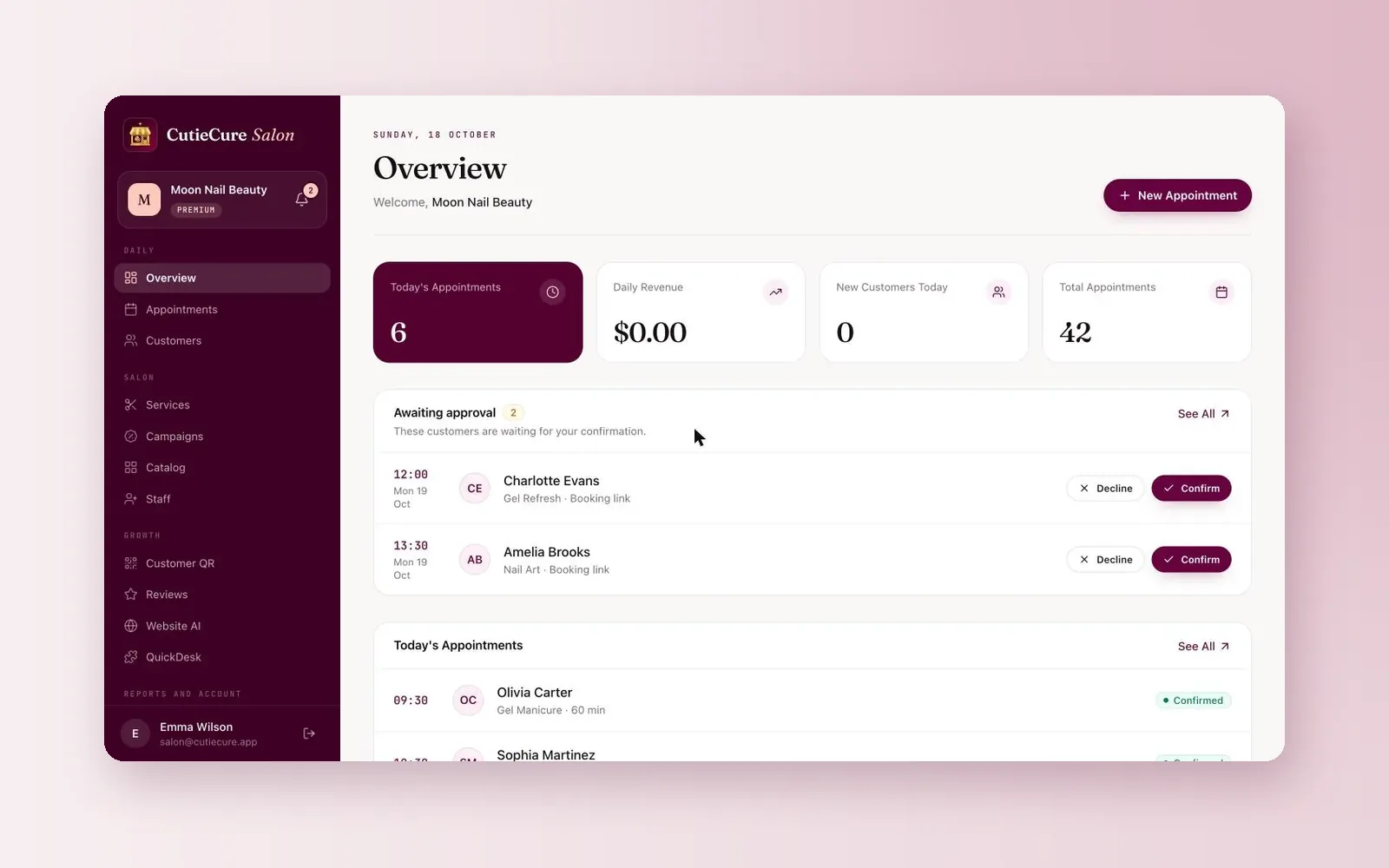
CutieCure Salon does not handle licenses, registrations, tax or legal paperwork, and it does not issue invoices or receipts. Those stay with your state board or council and your accountant. It helps once the doors are open:
- A booking link and a widget for your website, where clients book with a name and phone number. Online bookings arrive as pending for you to confirm.
- Client records with contact details, notes and visit history, for example a note that a client agreed to photos of her nails or reacts to a product. It is a notes field, not a signed consent form, so keep signed forms where your rules require them.
- WhatsApp reminders, up to three before each appointment, with one-tap confirm or cancel.
You can try it free for 14 days without a card.
Free tools and next steps
- Nail salon break-even calculatorSee how many appointments a month cover your costs and your own pay, and whether your bookable hours can fit them.
- Booking software for solo nail techsBooking and client management for solo nail techs: a booking link, a calendar on your phone, client notes and no-show tracking. No booking commission.
Frequently asked questions
What license do I need to open a nail salon?
In the US you usually need a personal nail or cosmetology license from your state board, and many states also license the salon itself. In the UK there is generally no national license, but some councils license treatments and insurers expect a recognised qualification.
Can I own a nail salon without being a licensed nail technician?
In some US states an owner who does not do nails can own a salon, as long as licensed technicians do the services and the salon holds its own license. Check your state board's rules on owners and managers before you plan around this.
How much does a nail salon license cost?
Fees differ by state, county, city and council and change over time, so ask each office for its current fee. Budget for the license, inspections, business registration, insurance and your accountant together.
Do I need insurance to open a nail salon?
Some cover is required by law once you have staff, and landlords often ask for liability insurance. Even where it is not required, public and treatment liability protect you if a client is hurt or has a reaction.
Does CutieCure Salon help with licenses or tax?
No. It handles bookings, client records and WhatsApp reminders once you are open. Licenses, registrations, tax and legal paperwork stay with the relevant offices and your accountant.
Written by the team that builds CutieCure Salon, booking software for nail salons. When the product or a fact in this guide changes, we update the guide and the date above.
Put this into practice with CutieCure Salon
Online booking link, website widget, packages, customer groups, campaign codes and team performance in one dashboard, plus AI try-on for your clients.