Nail Salon Redo Policy: When to Fix Nails for Free and How to Say It
Write a nail salon redo policy: what counts as a defect, the free-fix window, repairs you charge for, how to handle a request, and message templates.
By the CutieCure Salon teamPublished 7 min read
In short
- Decide in advance what you fix for free (lifting, early chips, a shape that is not what was agreed) and what you charge for (breaks from use, picking, another salon's work).
- Set a free-fix window per service type, ask for a photo, and book the fix as a real appointment instead of squeezing it in.
- Write the policy down, show it before clients book, and count redos per technician: a rising number points to training, products or durations, not to difficult clients.
- 1. Why a written redo policy saves you money and arguments
- 2. What counts as a redo, and what does not
- 3. Choose a free-fix window per service
- 4. Fix, repair fee or refund?
- 5. How to handle a redo request, step by step
- 6. Policy text you can copy
- 7. Who does the fix, and who pays for the time
- 8. Count redos and act on the pattern
- 9. Doing this in CutieCure Salon
Why a written redo policy saves you money and arguments
Every nail salon gets redo requests: a gel manicure that lifts after a few days, a nail that breaks, a client who is unhappy with the shape. Without a policy, each request turns into a negotiation, two technicians give two different answers, and the loudest clients get the most free work.
A short written policy does three things. It treats every client the same way, it protects your time and margin, and it gives your team a script, so nobody has to decide on the spot whether to say yes.
What counts as a redo, and what does not
Usually fixed free of charge
- Lifting or peeling within your free-fix window, when the client has looked after her nails normally.
- Chips or cracks that appear early without an obvious cause.
- A result that is not what was agreed: the wrong shape, length or colour compared with what you wrote down at the appointment.
- Visible workmanship problems spotted at or soon after the visit: uneven polish, flooded cuticles, a rough finish.
Usually a paid repair
- Breaks from use, such as a nail caught in a door or used as a tool.
- Damage from picking, biting or peeling the product off.
- Cleaning products or hot water without gloves, when that clearly caused the damage.
- Work done elsewhere, or nails filed or re-polished at home after the visit.
- A change of mind about a colour or design the client chose and approved.
Choose a free-fix window per service
The window is how long after the appointment a client can ask for a free fix. Choose one you can afford, and set it per type of service, because a gel polish manicure and a set of extensions do not wear the same way. Write it as days after the appointment, not "about a week", so there is nothing to argue about.
After the window, problems are wear, not workmanship, and they go to your normal repair or fill prices. A short "single nail repair" service on your menu makes that easy to book; the service menu guide shows how to set one up.
Fix, repair fee or refund?
- Free fix: the default for anything your policy covers. The client gets what she paid for, and you keep the relationship.
- Repair fee: for damage outside the policy or after the window, at your normal repair price. Say the price before you start.
- Refund: the exception, for when a fix is not possible or the client does not want you to touch her nails again. Decide who on the team can approve one.
Avoid turning a redo into a discount on the next visit by default. It feels generous but teaches clients that complaining lowers the price.
How to handle a redo request, step by step
- 1Thank the client for telling you. Most unhappy clients simply never come back.
- 2Ask for a photo of the nails and the date of the appointment.
- 3Check what was agreed: the notes from the booking and the client record, and your consultation form if you use one.
- 4Decide with the policy, not with your mood: free fix, paid repair or, rarely, a refund.
- 5Book the fix as a real appointment with enough time, ideally with the same technician.
- 6Record the redo and the reason on the client record, so you can spot patterns later.
Writing down what was agreed is what makes step 3 possible. The consultation guide covers what to record, and the free consultation form template prints one.
If the complaint arrives as a public review instead of a message, the same policy decides what you offer. The guide to responding to negative reviews has reply templates for the most common complaints.
Policy text you can copy
Adapt the numbers in brackets to your salon, then put the policy where clients see it before they book: your website, an Instagram highlight and the desk.
And three replies for WhatsApp or Instagram messages:
- Covered: "Thank you for letting us know, and sorry about this. That is covered by our fix policy. Can you come in on [day] at [time]? It will take about [minutes] minutes and there is no charge."
- After the window: "Thank you for the photo. Your appointment was [N] days ago, which is past our [X]-day fix window, so this is a repair at our usual price of [price]. Would [day] at [time] suit you?"
- Not covered: "Thanks for the photo. This looks like a break from an accident rather than a problem with the application, so it is not covered by the free fix. We can repair it for [price]. Shall I book you in?"
The WhatsApp messages guide has more templates and the etiquette around them.
Who does the fix, and who pays for the time
The same technician usually fixes her own work: she knows the set, and she sees the result of her technique. If she is not available, any technician can do it, and the owner should decide in advance how that time counts.
If you pay on commission, a free fix earns nothing. Write down whether the technician who did the original service does the fix unpaid, or whether the salon pays the fixing technician for her time. The nail technician pay guide covers the rules worth putting in writing.
Count redos and act on the pattern
Keep a simple count: redos per month, per technician and per service, with the reason. One redo means little; a rising number means something to fix.
- One technician, many redos: a training topic, not a disciplinary one. The 30-day training plan has a structure for it.
- One service, many redos: check the duration (rushed work lifts) and the product.
- One product or batch: check how it is stored and whether it is past its date; the inventory guide covers storage.
Doing this in CutieCure Salon
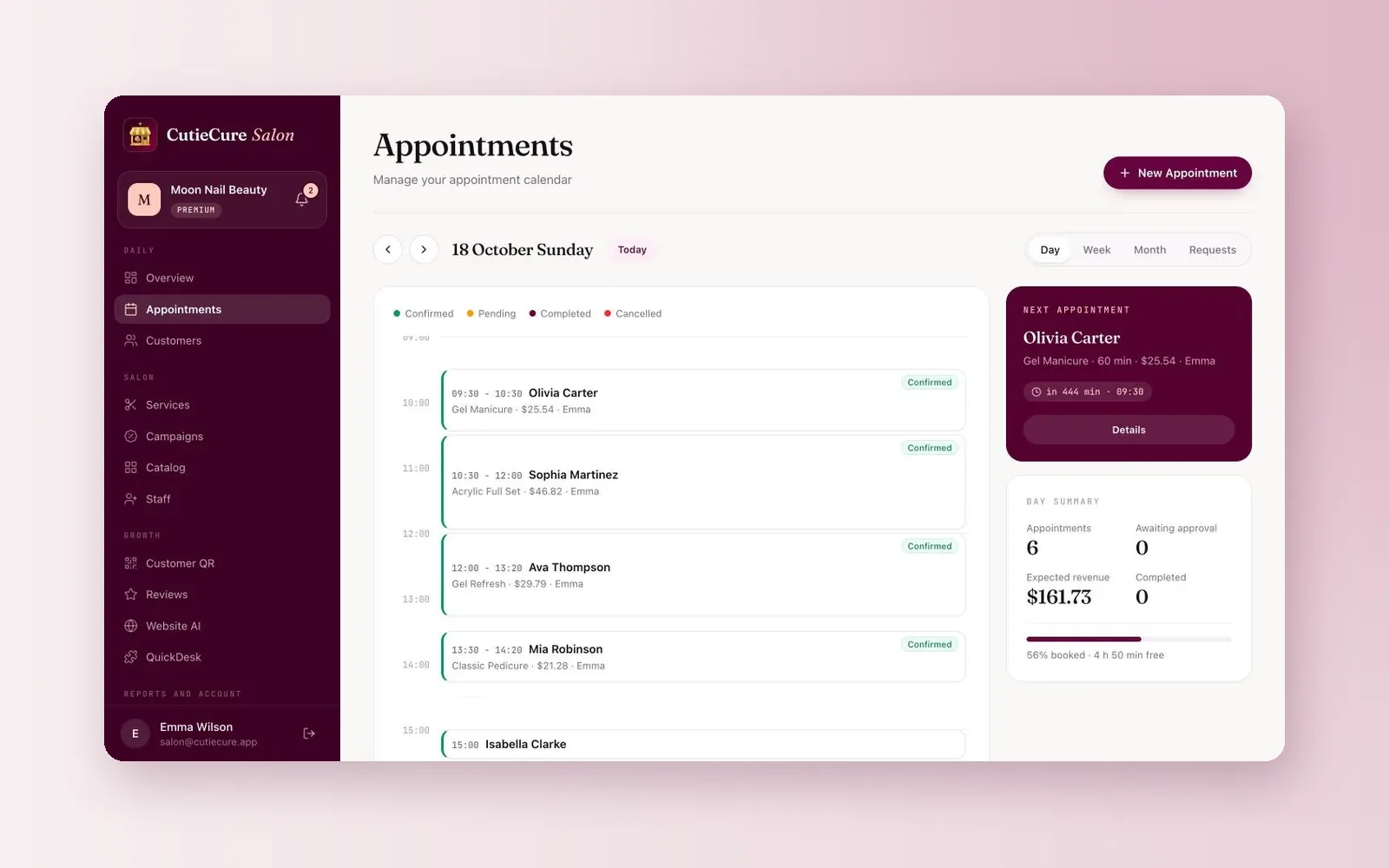
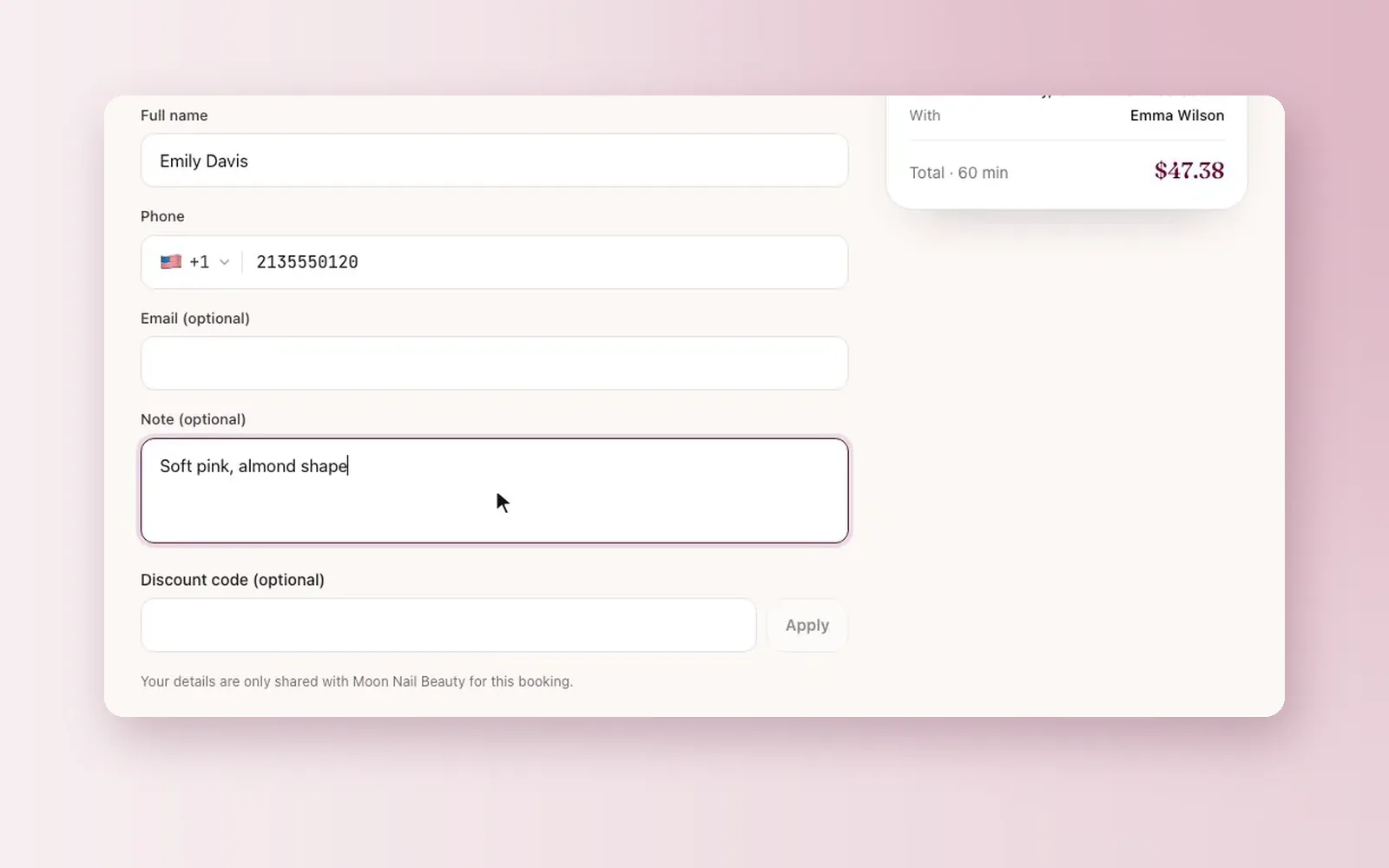
Clients can write what they want in the note field when they book, and you can keep allergies, preferred shapes and past problems in the notes on the client record, so the "what was agreed" check takes seconds. Book the fix as an appointment with a repair service so it holds the technician's time. CutieCure Salon has no separate redo report, so keep the count in your client notes or a simple spreadsheet.
Free tools and next steps
- Free nail client consultation form templateBuild a printable consultation form with your salon name: health, nail condition, preferences, service history and consent.
- Nail salon software for salons with a teamScheduling, roles and staff performance for nail salons with several technicians. Per-person availability, no booking commission, 14-day free trial.
Frequently asked questions
How long should a nail salon redo policy last?
Set a window per service type that you can afford, written as a number of days after the appointment. After it, problems count as normal wear and are repaired at your usual price.
Do I have to fix nails for free?
For problems caused by the service, a free fix is fair and often expected; consumer law where you work may also give clients rights. Damage from accidents, picking or work elsewhere can be a paid repair.
Can I refuse a redo?
You can decline a free fix when the damage is outside your written policy, and offer a paid repair instead. Explain the reason calmly and politely, and point to the policy the client saw before booking.
Should I refund or redo?
Redo by default. Keep refunds for the cases where a fix is not possible or the client does not want to come back, and decide in advance who can approve them.
Who pays for the technician's time on a redo?
Decide it in advance and write it down: either the technician who did the original service fixes it without extra pay, or the salon pays the fixing technician for her time.
Written by the team that builds CutieCure Salon, booking software for nail salons. When the product or a fact in this guide changes, we update the guide and the date above.
Put this into practice with CutieCure Salon
Online booking link, website widget, packages, customer groups, campaign codes and team performance in one dashboard, plus AI try-on for your clients.